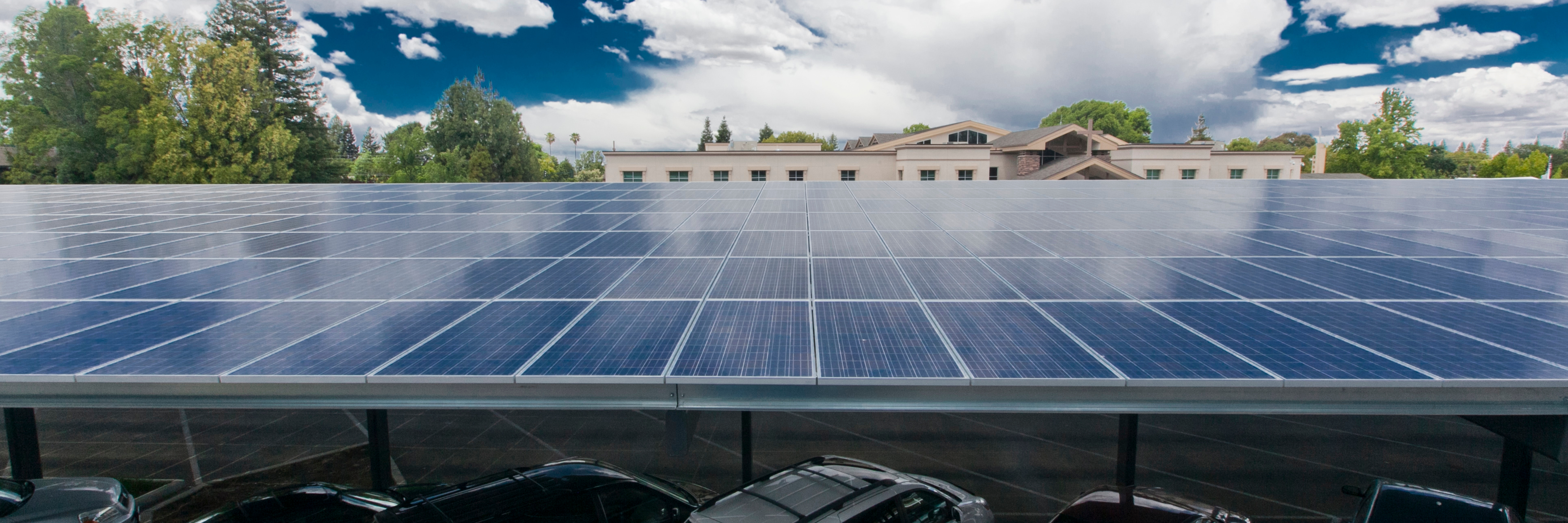
The call we hoped no owner would ever have to make
A property owner got in touch with us recently about a solar canopy that was only five years old and already coming apart. They hadn't installed it with us. They'd gone with another company, and by their own account, the deciding factor was price. We sent a team out to take a look.
What we found was a structure failing well ahead of schedule. A solar canopy should outlast its warranty, not give out inside it. This one had problems you could spot from the parking lot.
What we found on site
The failures came down to the two things that matter most in a canopy: the structure holding the panels up, and the hardware holding the panels down.
The wood members of the canopy frame had twisted and warped, pulling the whole array out of plane.
Several panels had lifted at the edges where the frame moved beneath them.
Many of the module clamps, the small fasteners that lock each panel to the rails, were simply missing.
A panel held by too few clamps is one storm away from becoming a sail. On a carport or canopy, a lifted module is not just a production problem. It is a liability sitting over cars, equipment, or people.
None of this is normal wear for a five-year-old system. Quality canopies are engineered for decades of wind, heat, and weather. When a frame twists and fasteners go missing this early, it points to the materials and the installation underneath, not to bad luck.
The warranty that vanished
Here is the part that turned a repair bill into a hard lesson: the company that built the canopy is no longer in business.
That single fact erased the owner's safety net. A workmanship warranty is only a promise, and a promise is only worth the company standing behind it. When the installer closes its doors, the warranty closes with them. There is no one to call, no one to send a crew, no one to make it right.
This is the risk that rarely gets discussed when people compare bids. Equipment manufacturers may still honor the panel or inverter warranty, but the manufacturer did not twist your frame or leave out your clamps. Workmanship is on the installer, and a workmanship warranty from a company that no longer exists is a piece of paper.
So the owner was left with a five-year-old system, a growing list of defects, and nobody obligated to fix any of it.
The math nobody wants to run
The owner now has to bring in a reputable company to do what should have been done once. That means re-engineering and rebuilding compromised sections of the structure, removing and resetting lifted panels, replacing missing and failed hardware, and inspecting the rest of the array for damage that has not shown itself yet.
Remediation like this routinely runs into the tens of thousands of dollars, because a repair crew has to work around an existing installation, correct someone else's mistakes, and re-certify the result. It is almost always more expensive than building it right the first time.
The premium for a quality builder up front is usually a modest percentage of the project. The cost of fixing a failed one is a second project on top of the first. The owner did not save money by choosing the low bid. They deferred a much larger bill, and it came due in five years instead of twenty-five.
How to vet a builder so this never happens to you
"Buy quality" is easy to say and hard to act on when every bid claims to be quality. Here is what actually separates a canopy that lasts from one that fails. Ask every bidder these questions before you sign.
How long have you been in business, and will you still be here in 20 years? Longevity is the single best predictor that your workmanship warranty will mean something. A company that has weathered multiple economic cycles has shown it can honor long-term commitments.
Who holds the structural engineering, and is the canopy stamped by a licensed engineer? A canopy is a building, not a bracket. The structure should be designed for your site's wind and seismic loads, not copied from a template.
What are the frame materials and the fastener spec? Ask specifically how panels are clamped to the rails and are those connections correctly torqued and checked? Missing clamps are a workmanship failure, not an accident.
Are you properly licensed for both the electrical and the structural scope? Solar on a canopy touches electrical, general building, and sometimes solar-specific trades. Confirm the licenses cover all of it.
What exactly does the workmanship warranty cover, for how long, and who performs the service? A long warranty from a shaky company is worth less than a shorter one from a company that will clearly still be standing.
If a bid is dramatically cheaper than the others, that gap is not generosity. It is coming out of the engineering, the materials, the labor, or the company's ability to stick around. Ask where.
Why this matters to us
We have been installing solar in the Bay Area for roughly 50 years. We mention that not to brag, but because it is the whole point of this story. The warranty we write today only has value if we are still here to honor it, and five decades in business is our evidence that we will be.
That longevity shapes how we build. We would rather lose a bid on price than win it and watch a structure fail with our name on it. Quality materials, properly engineered structures, and workmanship we stand behind are not upsells. They are the reason a system still performs long after the cheaper option has been torn down and rebuilt.
If you are weighing solar canopy bids and one of them looks too good to be true, we are happy to give you a second opinion before you commit, or to assess an existing system that is not aging the way it should. It is a lot less expensive to ask the right questions now than to pay for the same canopy twice.
